Israeli Defense Minister Yoav Gallant Faces Political Turmoil Amid Rising Tensions in Israel

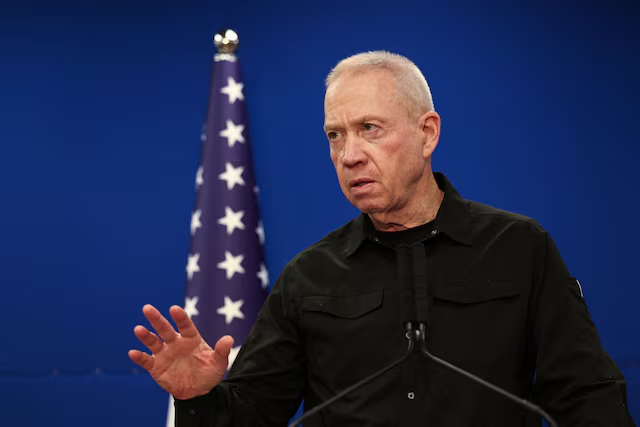
In a dramatic political development, Israeli Defense Minister Yoav Gallant has found himself at the center of a national storm following recent decisions made by Prime Minister Benjamin Netanyahu. Gallant’s tenure as defense minister has been marked by a mixture of tactical brilliance and internal political challenges, with his most recent firing creating ripples not only within Israel but also internationally. The political backdrop to Gallant’s ousting and his ongoing influence on the Israeli political landscape provides a critical lens into Israel’s defense strategy amid escalating threats from adversaries.
Main Points
Yoav Gallant: A Brief Overview
Yoav Gallant, appointed as Israel’s Defense Minister in 2023, quickly earned a reputation for his straightforward and no-nonsense approach to defense. Before assuming the role of defense minister, Gallant was a decorated military officer in the Israel Defense Forces (IDF). His experience in security and military strategy gained him credibility in national security circles, making his appointment a significant one for the country’s defense policy.
A key figure in managing Israel’s response to various security threats, Gallant’s military background and leadership style have been integral to his role. However, despite his credentials, Gallant has faced increasing political friction with the government, particularly with Netanyahu’s administration.
Gallant’s Ouster: Political Fallout
Gallant’s firing was a dramatic turn of events, coinciding with increasing calls for the government to address Israel’s ongoing security challenges. Sources close to Netanyahu indicated that the decision to dismiss Gallant was due to a lack of alignment on critical security matters. In particular, Netanyahu’s office has accused Gallant of undermining national security policies, resulting in political tensions within Israel’s coalition government.
The timing of Gallant’s dismissal raised eyebrows, coming during one of the most critical phases in Israel’s national defense strategy. Some critics argue that removing Gallant in such turbulent times might create instability within the defense sector, at a time when the country faces rising threats from militant groups and geopolitical tensions in the region.
Public and Political Reaction
Gallant’s ousting has sparked a mix of public outcry and political support. While some members of Netanyahu’s Likud party and other coalition partners support the move, citing Gallant’s failure to maintain unity within the government, opposition groups have criticized the decision. The left-wing political factions in Israel have condemned the firing as a dangerous political maneuver that could jeopardize the country’s security at a time when strategic decisions are more crucial than ever.
The opposition also voiced concerns that Gallant’s dismissal was politically motivated, with some speculating that Netanyahu’s attempt to consolidate power and sideline critical voices within his administration is behind the decision. Gallant himself has expressed his dismay at the firing, noting that his commitment to Israel’s security is unyielding, and that his decisions were always aimed at the country’s defense and long-term stability.
Gallant’s Legacy and Influence on Israeli Defense
Despite the political turmoil, Gallant’s contributions to Israel’s defense strategy cannot be overlooked. As Defense Minister, Gallant was responsible for overseeing Israel’s military operations and defense policy, including the country’s operations against militant groups in Gaza and the broader Middle East. His military background provided him with a deep understanding of Israel’s defense needs, allowing him to navigate complex security issues with experience.
Gallant played a key role in reinforcing Israel’s defense posture, particularly regarding threats from Iran and Hezbollah. Under his leadership, the IDF has carried out several key operations aimed at neutralizing threats, bolstering Israel’s position in the region.
Future of Gallant and His Role in Israeli Politics
With Gallant’s ouster, the future of Israel’s defense policy remains uncertain. Netanyahu’s government now faces the challenge of finding a suitable replacement, one who can maintain the balance of power in Israel’s defense establishment and carry forward Gallant’s strategies.
Political commentators suggest that Gallant may remain an influential figure within the Israeli political scene. Given his military background and strong public profile, it’s possible that Gallant will continue to play a pivotal role in shaping Israel’s security policy, either from a political or defense-related standpoint.
International Reactions and Israel’s Global Alliances
Gallant’s firing has had ripple effects beyond Israel’s borders. International reactions, especially from allies like the United States and European Union members, have raised concerns about the impact on Israel’s security posture. Gallant’s removal comes at a time when Israel is engaged in several critical military alliances and operations, especially with regard to counterterrorism efforts and the security of its borders.
The global community is closely monitoring the developments, as Gallant’s tenure as Defense Minister had bolstered Israel’s strategic relationships with key allies. How Israel’s defense policy will evolve following Gallant’s dismissal will likely influence its international relations in the coming years.
An Ongoing Debate
The debate surrounding Yoav Gallant’s ousting is far from over. With Israel’s defense minister being one of the most crucial positions in the government, the implications of this decision are profound. Whether this marks the end of Gallant’s political career or the beginning of a new chapter in Israeli politics is yet to be seen.
For now, the nation watches closely as Israel navigates through a turbulent period, balancing the intricacies of internal politics with the undeniable security challenges facing the state. Gallant’s legacy, however, will continue to shape discussions on Israel’s defense, and his future in Israeli politics will likely remain a topic of significant interest for both domestic and international observers.
The ongoing drama within Israel’s political landscape reflects broader regional challenges and highlights the complexity of leadership in a nation constantly on alert for threats to its sovereignty.


